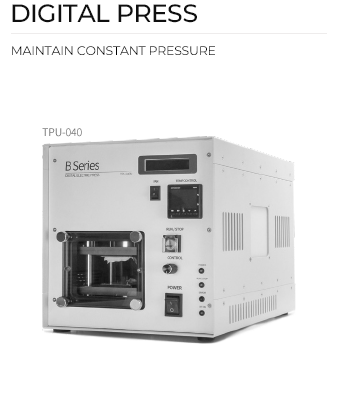
DIGITAL PRESS
Electronic press for solid-state battery evaluation
View details ↗
TERA LEADER / RESEARCH EQUIPMENT
Explore cell jigs, pressure and measurement equipment, temperature-controlled test equipment and materials processing equipment.
3 results
Electronic press for solid-state battery evaluation
View details ↗Hydraulic loading equipment for research tests
View details ↗Load display instrument using load cell signals
View details ↗SOLID-STATE BATTERY RESEARCH
Explore the research chain from materials and interfaces to cell evaluation, safety, manufacturing and sustainability. Open a topic to read more.
This is a research guide. Product links identify relevant TERA LEADER equipment; suitability depends on the model, configuration and experimental conditions.
Research on the composition, synthesis, crystal structure, ionic conductivity and stability of sulfide, oxide, halide, polymer and composite electrolytes.
Relevant equipment
Cathode formulations, electrolyte and conductive-additive networks, binders, ion/electron transport and high-voltage stability.
Lithium plating and stripping, volume changes and dendrites in lithium-metal, silicon, tin, graphite and anode-free cell configurations.
Relevant equipment
Interfacial reactions, resistance, contact loss, voids, cracks, coatings, protective layers and adhesion.
Relevant equipment
Pellet and electrode forming, densification, stacking, alignment, current-collector contact and repeatable cell assembly.
Relevant equipment
Formation pressure, operating stack pressure, cycling-induced load and thickness changes, and coupled electrochemical–mechanical behavior.
Relevant equipment
Temperature effects on ionic conductivity, interfacial resistance, cell performance and coupled temperature–pressure conditions.
Cycling, rate capability, impedance, polarization, conductivity and lithium transport, including fixtures and temperature equipment used with separate electrochemical analyzers.
Relevant equipment
Diffraction, spectroscopy, microscopy, tomography and in situ/operando observation of structures, chemistry, interfaces, cracks and lithium behavior.
Internal shorts, dendrite penetration, heat generation, thermal runaway, overcharge and mechanically induced failure mechanisms.
Cycle and calendar aging, repeated pressure/temperature conditions, test variability and measurement uncertainty.
Powder, slurry and binder design; dry/wet processing; thin-film formation, coating, calendering, sintering and low-temperature densification.
Large-area electrolyte films, multilayer stacks, pouch-cell assembly and sealing, uniform pressure, throughput, yield and quality control.
Relevant equipment
Moisture/oxygen sensitivity, gas evolution from sulfide materials, drying, storage, transfer and glovebox/dry-room conditions.
Materials discovery, atomistic/continuum and multiphysics modeling, interface/stress prediction, experimental design and data-driven performance/degradation analysis.
Recovery and reuse of electrodes/electrolytes, raw-material supply, process energy, life-cycle impacts and manufacturing economics.
SOLID-STATE BATTERY RESEARCH
Tell us your jig, measurement and component requirements. R&D requests are reviewed for technical fit, scope and available resources.